
Elsa Biston, Aussi Fragile Que Possible
A sound installation conceived and
composed by Elsa Biston.
Should we always show strong, legible, deliberate and controlled gestures?
Or can we, on the contrary, allow the undecided, the
blurred, the barely perceptible to emerge — and offer it a space for listening and existence?
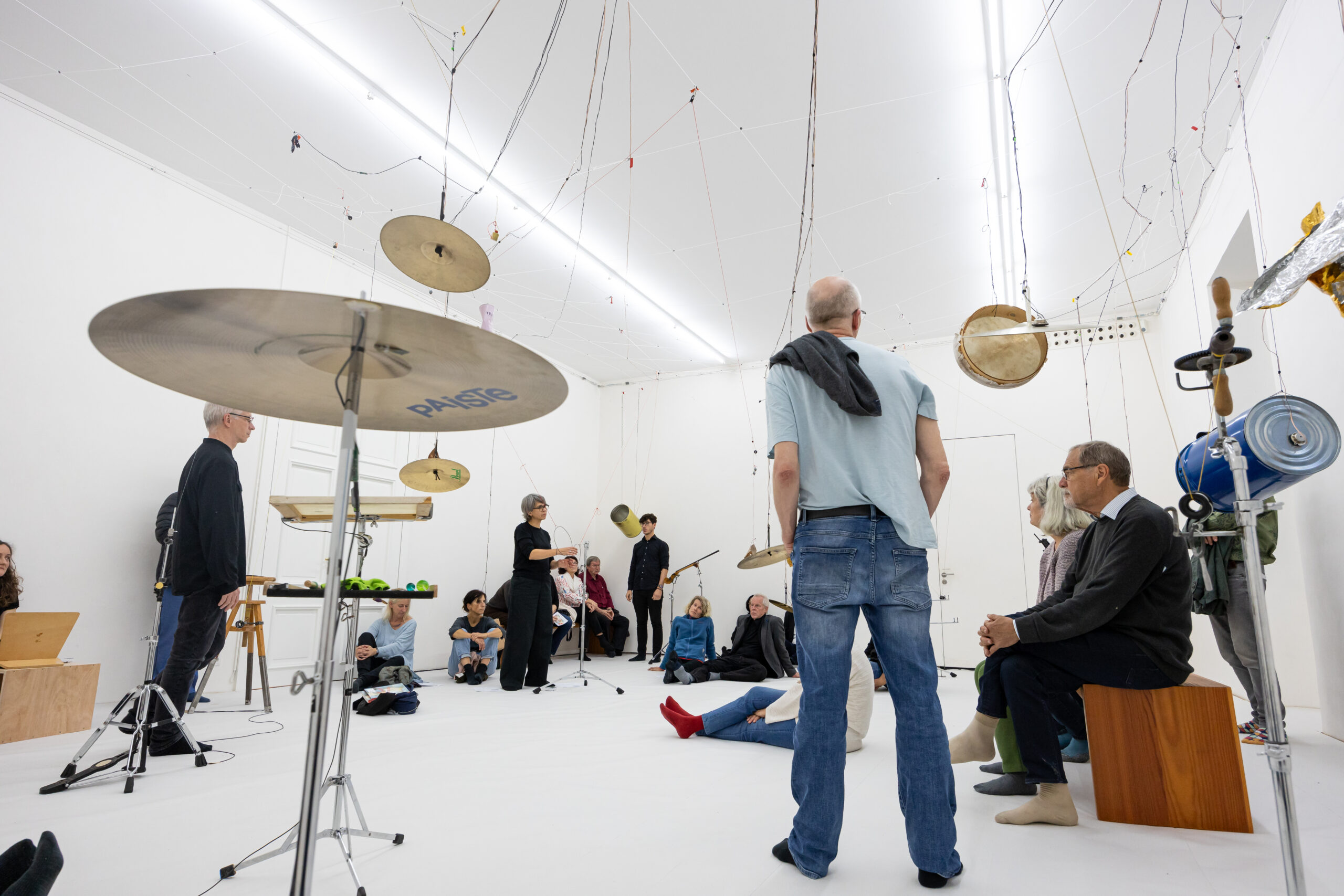
Aussi Fragile que possible is a sound installation conceived and composed by Elsa Biston, with musical performances by the contemporary music ensemble United Instruments of Lucilin and a scenography by Andréa Baglione.
Halfway between an artistic proposal and a sensory experience, the installation invites the
audience to focus their attention on subtle and fragile sound phenomena. It proposes a relationship to sound based on listening, slowness, and letting go, in contrast to spectacle and control.
Visitors are invited to become sensitive interpreters of the installation. With the help of a set of
instructions, they remotely manipulate simple objects—a piece of plastic, dead leaves, a can, a ping-pong ball—through a system of pulleys and strings stretched throughout the space.
These objects lightly brush cymbals distributed throughout the installation and set into vibration by transducers*
. Under
the effect of this vibration, the object rebounds on the cymbal according to a repetitive yet random rhythm — timid, yet
persistent.
Other vibrating objects — containers, drums, papers — amplify and extend these rebounds according to a changing
score. Together, they form a dense landscape of vibrating and resonating objects that react to one another: the vibration
of a cymbal causes a dead leaf to tremble, which resonates inside a drum, setting a drumstick in motion. The objects
touch one another through vibration.
Musical performances:
During 35-minute performances, four musicians from United Instruments of Lucilin join the audience at the heart of the installation. Their playing, captured in extreme proximity and strongly amplified, triggers chain reactions throughout the entire system: the slightest touch becomes a major sonic event, setting papers, cymbals and objects vibrating across the space.
The musicians then become mediators
between the audience and the installation,
collectively orienting and focusing listening at
various points within the dispositif. Their own
relationship to their instruments is
transformed: the instrument becomes the
installation itself, with its share of indeterminacy and lack of control.